
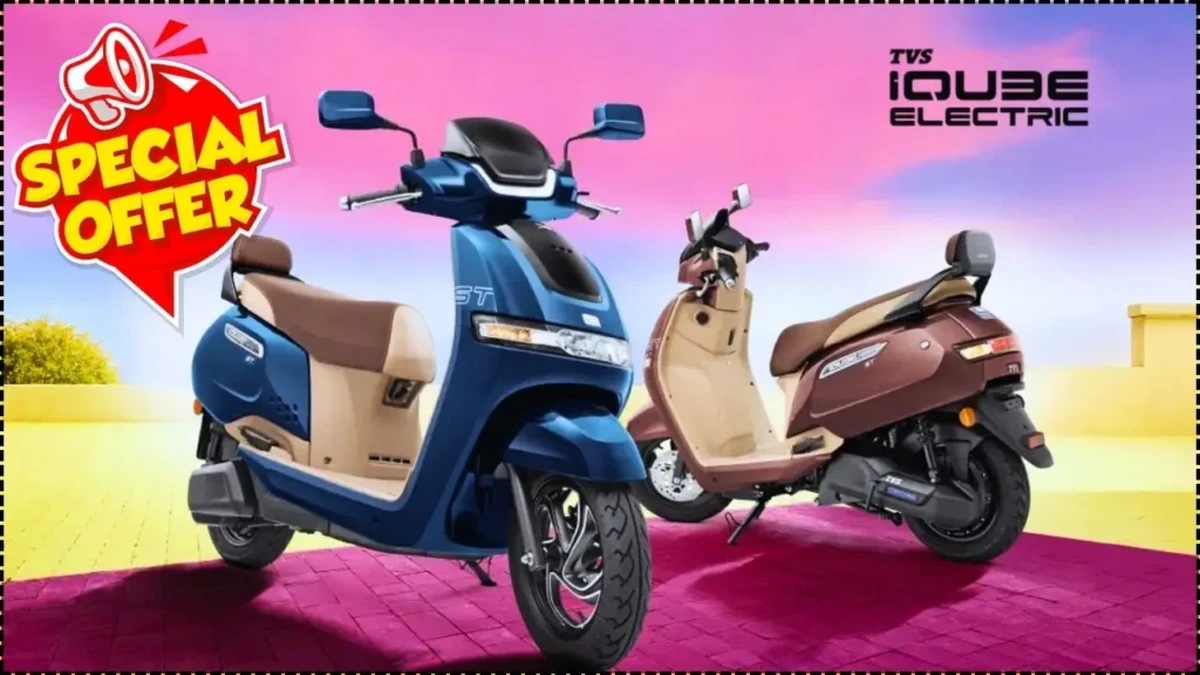
If that headline grabbed your attention, you’re not the only one. The notion of a TVS iQube achieving 545 km on a single charge, recharging in just one hour, and costing only ₹55,000 seems incredibly appealing—but it doesn’t accurately represent the scooter’s actual specifications, real-world performance, or market value. The current iQube range achieves a certified range of up to 212 km (IDC) on the ST 5.3 kWh model. Home charging utilizes a portable charger and requires several hours, not just one hour, to fully replenish. Prices for the 2025 models start in the six-figure range, depending on the specific version and location. Therefore, treat the “bumper offer” and exaggerated claims as viral marketing or promotional tactics, rather than reliable information for making purchase decisions.TVS iQube Electric Scooter
The scooter’s official specifications indicate a practical city vehicle designed for dependability, integrated features, and convenient home charging, not a 545 km touring vehicle with rapid charging. The iQube series includes various batteries: a basic option for quick city journeys, intermediate options for enhanced range, and the premium ST 5.3 kWh model with the longest certified range. Charging durations vary based on the battery and charger power; the portable charger experience is designed for gradual top-ups over a longer period, rather than rapid DC charging. Regarding pricing, expect to see typical EV-scooter figures, not a remarkably low price, even with incentives.
Table of Contents
- TVS iQube Electric Scooter
- What’s Actually New For 2025
- Range And Charging Realities
- Variants And Who They Suit
- TVS iQube Electric Scooter Pricing, Subsidies, And The ₹55,000 Headline
- Features That Matter Every Day
- Buying Advice
- Is Claim Real?
- How To Evaluate Big EV Claims
- Who Should Buy The iQube
- FAQs on TVS iQube Electric Scooter
- What Is the Real Range of the TVS iQube ST?
- Does The TVS iQube Support 1-Hour Fast Charging?
- What Are The 2025 Prices For iQube S And ST?
- Which iQube Variant Is Best for City Commuting?
TVS iQube Electric Scooter
Official top IDC rangeTypical 0–80% chargingBattery options2025 price pointers (ex-showroom)Top speed (varies by variant)Charging methodConnected featuresUse case
Focus on the realistic promise, not the eye-catching headline. The TVS iQube is not a miracle scooter capable of 545 km range, one-hour charging, and a ₹55,000 price tag. Instead, it is a well-engineered urban EV with a confirmed range, convenient portable home charging, and models suited to various Indian riding habits. If you base your expectations on IDC versus real-world range, realize that portable charging is a gradual convenience, and confirm the on-road price with an authorized dealer, you will get a scooter that satisfies your needs: a quiet, convenient, and economical mode of transportation for everyday use.
What’s Actually New For 2025
The iQube series received significant improvements focusing on practical range, linked technology, and practicality. The long-range ST model, with a certified 212 km IDC range, remains a standout, providing city riders with sufficient range for several days of commuting with sensible riding. Mid-range models (typically in the 3–3.5 kWh range) provide a good mix of price and range, making them ideal for people who desire fewer charging sessions without upgrading to the flagship model. Basic models are designed for short-distance users who value lighter weight and quicker top-ups from low charge levels. The overarching theme is consistency and convenience, which encompasses ease of ownership, home charging, and consistent day-to-day range.
Range And Charging Realities
There are two key facts to remember. First, the IDC range is a standardized lab measurement; it is useful for comparisons, but exceeds actual mixed-use riding outcomes. In practice, actual range is impacted by traffic, speed, terrain, rider weight, and weather. Second, portable chargers prioritize convenience and battery life over sheer speed. As a result, a 0–80% charge usually takes several hours, not a single hour; this design decision enables daily use without the need for specialized infrastructure. If your daily commute is 30–50 km, an overnight charge keeps things predictable. Plan for extended charging times, rather than expecting DC fast-charging speeds, if you’re riding for longer distances.
Your TVS iQube, now on your wrist.
The TVS iQube Noise Smartwatch is here. And with it, TVS iQube becomes India’s first electric scooter with smartwatch integration.
Head to our website to get yours! pic.twitter.com/I5B09kBWtj
Variants And Who They Suit
- Entry Battery (around 2.2 kWh): Ideal for short, congested urban commutes, delivery trips, and predictable schedules with simple access to home or workplace outlets. Its lightweight feel, quick responsiveness, and faster 0–80% replenishment from low SOC make it simple to use in metropolitan areas.
- Mid Battery (around 3.1–3.5 kWh): The best choice for most purchasers. Anticipate a substantial boost in IDC range, greater flexibility for suburban-to-city commutes, and fewer charging stops per week. This class feels perfect if you routinely switch between Eco and Power modes and engage in occasional ring-road sprints.
- ST 5.3 kWh: The range leader with a 212 km IDC claim, designed to alleviate range anxiety if your daily routine is unpredictable. This is the best option for riders who take numerous journeys, occasional weekend errands around town, or simply want the greatest range without having to carefully manage the throttle.
TVS iQube Electric Scooter Pricing, Subsidies, And The ₹55,000 Headline
The cost of the 2025 iQube is much more than ₹55,000. Even with federal and state EV incentives, the starting ex-showroom prices for standard versions are high enough that a sub-₹60,000 investment would typically indicate a booking cost rather than total ownership, a highly advertised local initiative with restrictions, or a discrepancy between the claim and the model being offered. Always get a breakdown of the deal: ex-showroom price, insurance, registration, handling, charger cost (if invoiced separately), and any accessory packs. Verify your state’s subsidy eligibility and schedule. Request a complete on-road quote in writing and compare it to two authorized dealerships in your city to avoid surprises.
Features That Matter Every Day
The iQube lineup prioritizes the elements that riders use daily. Expect a linked cluster with navigation, call/SMS notifications, remote charge status, distance-to-empty, trip metrics, and over-the-air update capabilities, depending on the version. Ergonomics are family-friendly, with adequate storage for daily necessities. Top speeds of around 75–82 km/h are appropriate for metro expressways and ring roads while maintaining battery efficiency. The braking and suspension systems are designed for Indian roads, providing predictable, forgiving, and confidence-inspiring performance across monsoon potholes and uneven asphalt. The end result is a commuter EV that blends into your daily routine rather than requiring extra planning.
Buying Advice
- Informational intent: If you’re just learning, concentrate on variant differences (battery size, display, features), IDC vs. real-world expectations, and charging time realities. IDC is a benchmark; your actual range is determined by context.
- Transactional intent: If you plan to book soon, select two versions based on your daily mileage. Most city riders prefer the 3–3.5 kWh class; long-city runners and range-maximizers gravitate toward the ST 5.3 kWh. Request on-road quotations, schedule test rides, and inquire about charger inclusion and delivery timelines.
- Navigational intent: If you’re seeking official information, go to the manufacturer’s model, variant, and price pages. For a quick comparison, consult a reputable auto portal. Verify the availability of your city and color selections, as dispatches may be staggered.
Is Claim Real?
TVS iQube Electric Scooter with 545 KM Range & 1-Hour Fast Charge: Bumper Offer at ₹55,000 remains a popular topic, most likely because it is so clickable. However, it does not reflect the manufacturer’s advertised range and charging profile, nor the market pricing for 2025 models. Consider it a warning story about vetting EV claims: long range and super-fast charging frequently need huge battery capacities, high-voltage architectures, and specialist chargers. Scooters built for urban India, with portable home charging and robust aftersales support, are based on a different principle: dependability, convenience, and total cost of ownership.
How To Evaluate Big EV Claims
- Check the variant name and battery capacity. A “range” claim without battery context isn’t useful.
- Look for clarity on the test cycle (IDC vs real world) and charger type/output. One-hour claims often imply specialized infrastructure.
- Confirm whether the quoted price is booking, ex-showroom, or on-road. Ask for a detailed cost sheet.
- Scan warranty terms for the battery and the availability of service centers in your city.
- Weigh your real daily use. If you ride 35–60 km a day, a mid-pack battery with overnight charging is often the quiet hero.
Honda Activa Electric Scooty with 485KM Range and Fast Charging Introduced at ₹68,000- Exclusive Launching Deals
Who Should Buy The iQube
The iQube series is an excellent choice if your routine emphasizes predictability, low running expenses, and a well-established service network. Entry-level versions are appropriate for compact-city riders who value low-cost ownership and quick top-ups. The 3–3.5 kWh class provides a reassuring middle ground: fewer plugs per week, flexible weekend runs, and robust feature sets. The ST 5.3 kWh variant is the premium option for those who want a long range, minimal charge anxiety, and more sophisticated technology. Across the board, you’re investing in an ecosystem based on daily ease, not record-breaking performance.
FAQs on TVS iQube Electric Scooter
What Is the Real Range of the TVS iQube ST?
Expect the certified up to 212 km IDC to trend lower in mixed riding. With careful throttle, urban speeds, and favorable conditions, you’ll come closer; with higher speeds and heavier loads, expect less.
Does The TVS iQube Support 1-Hour Fast Charging?
The iQube’s home-charging setup with a portable charger is designed for several hours to replenish, not one hour. Plan for overnight or daytime top-ups, which pairs naturally with city commuting.
What Are The 2025 Prices For iQube S And ST?
Ex-showroom prices for 2025 commonly start in the six-figure range for S variants and extend higher for the ST 5.3 kWh. Final on-road prices depend on city, insurance, and accessories.
Which iQube Variant Is Best for City Commuting?
For most riders, a mid-battery around 3–3.5 kWh balances price and range for 40–70 km daily patterns. Choose the ST 5.3 kWh if you want the highest buffer and fewer charging sessions through the week; pick the entry pack for short, predictable city loops.